

Moment of revelation in the archives
Luck played a large part in my discovery of a short letter written on the morning of a murderer's execution

If I were to break down my categories of enjoyment in writing true-crime books, this would be the top four rundown:
Doing research
Conducting interviews
Writing the book
Editing the book
I wonder how other authors would place these parts of the process. For me, sitting in archives and reading old books and documents is hugely interesting, a voyage into unforeseen aspects of a subject that until then had eluded me.
Taking and sorting notes and references can be dull, but finding out new episodes in the lives of people involved in extraordinary past events is a great thrill.
Meeting experts – in my case often former detectives, criminologists or forensic psychologists – is a privilege and an adventure.
Watching the detectives
For my first book, The Hunt for the 60s Ripper, two former Met detectives drove me to all the crime scenes, which were in various West London streets. They gave me a detective’s-eye view of how modern officers would assess the murders and where an investigation in the 1960s may have gone wrong.
Their generosity in spending most of a day with me and sharing their expertise, which I could never have achieved on my own, was invaluable. I’ll still often fall back on what I learned that day. Thank you, Brian and Andy.
Sitting down and writing a book is a long process. However, I find writing similar to reading in that by placing events in order you finally get a clearer sense of what happened and sometimes a better insight into why.
Editing is obviously a necessity and something of a slog. And to add insult to injury, it has to be done twice, once on our own before submitting the final manuscript and then in tandem with the publisher’s editors, usually jack-booted members of the grammar gestapo.
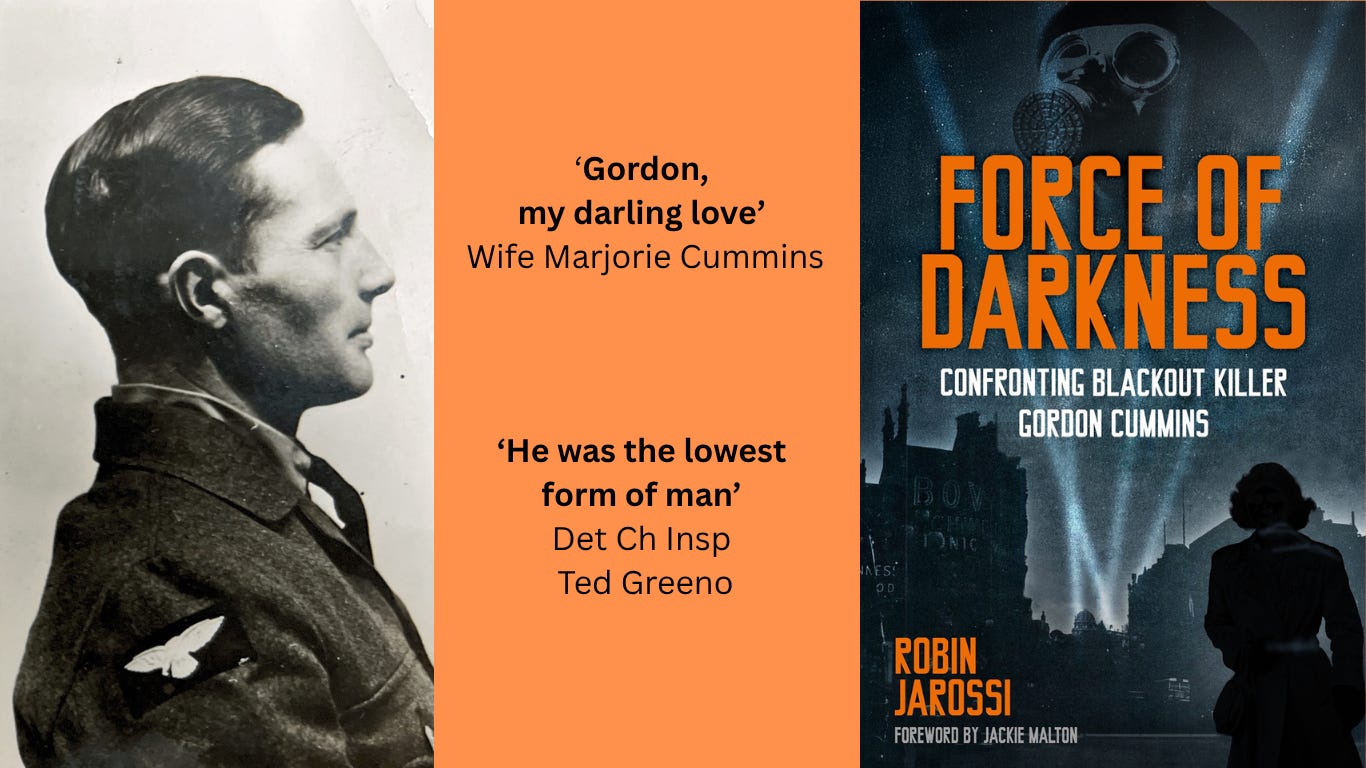
For my forthcoming book, Force of Darkness: Confronting Blackout Killer Gordon Cummins (History Press, published on 20 August), I was lucky to speak to forensic clinical psychologist Dr Caroline Logan.
Again, her willingness to help me meant I could include her deductions and insights into a murder case without parallel.
I suppose it is ironic that on this occasion it was my least favourite aspect of producing the book – fact-checking my own words as part of the editing – that enabled me to stumble on the most jaw-dropping revelation.
With the manuscript finished, I was just doing final checks on it. I returned to the London Metropolitan Archive for the boring task of simply double-checking the references for a couple of documents I wanted to cite in the book.
On the catalogue I noticed there happened to be a file dealing with a few items about Cummins’ time in HMP Wandsworth. I had not previously looked at this slim folder because there was an abundance of material on his prison stay at the National Archives in Kew, which I had already scoured.
As this was going to be a quick trip to the Metropolitan Archive, I thought I’d flip through the Wandsworth folder, not expecting to find anything I had not already found at Kew and during a visit I was invited on to the prison itself.
Cummins’ final request
And there it was in the old brown folder – a short letter written by the condemned man 30 minutes before his execution.
I won’t give a spoiler here about its contents because it might detract from a reader of the book’s curiosity in the unfolding story.
However, I was stunned by this discovery. I rushed outside the archive, which is in Clerkenwell, to phone my wife about it.
I had not seen the contents expressing his final thoughts anywhere – in no books on the case, not in podcasts, not in the memoirs of men such as the lead detective, not in police reports following the execution.
It certainly throws another twist onto our view of this puzzling, disturbing killer.
Moreover, it opens new questions about how those who loved and supported him through the trial and appeal – particularly his wife, Marjorie, parents and sister – must have assimilated his final shattering communication.