


I had to go to jail. It was my first time inside and worse than I imagined. Scary, disorientating and spirit-sapping.
Wandsworth Prison in south London. An institution opened in 1851, today it is rundown and crying out for, what – investment, modernisation, demolition? Built to hold 1,000 prisoners, it now contains some 1,500 and is dogged by accounts of overcrowding, violence and staff shortages.
HM Inspectorate of Prisons cited a dismaying seven suicides in 12 months in its 2024 report. It makes for shocking reading.
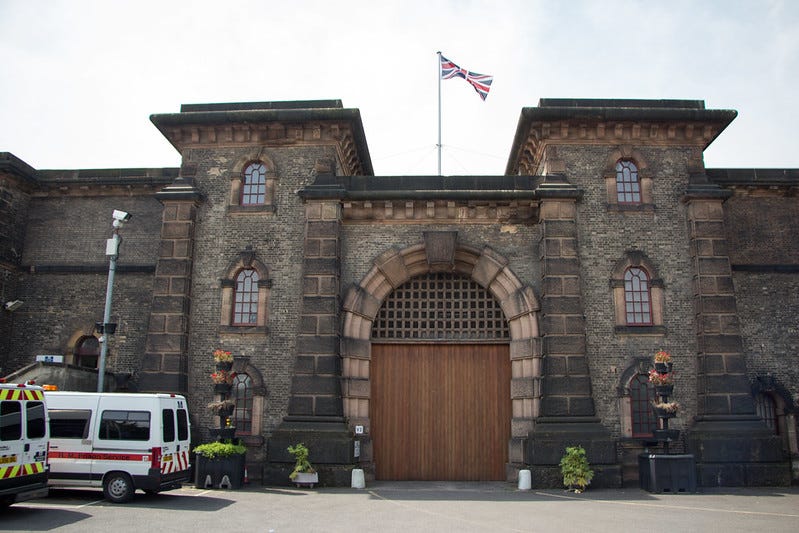
If Wandsworth’s thick walls could tell tales from its past, these would be of birchings, 135 executions between 1878 and 1961, and the confinement of the likes of Oscar Wilde, Ronnie and Reggie Kray, and the traitor William Joyce (Lord Haw Haw).
It was the institution’s grim past that brought me there on a wet morning last month. And so I was delighted that my spell behind bars was scheduled to last only a little over an hour.
The Blackout Murders
I was there to do research for my next book, Force of Darkness: Confronting Blackout Killer Gordon Cummins, due for publication on 20 August (the History Press). Cummins was executed at Wandsworth in 1942.
He had been an RAF cadet. In an unremitting burst of violence, he attacked six women in one week in February 1942, killing four of them. The story of how two women survived his assaults – one fought him off – and the tragedies of his victims, along with his wife and family, who could not believe his guilt, is compelling and moving.
I saw the execution suite where he spent his last months (now a staff room for prison officers) and the execution chamber where the gallows had been. This is now a storage room.
Cummins is still buried in what was once the prison’s cemetery. However, today this is under tarmac, serving as a road within the prison grounds.
Condemned cell
The accused was never allowed to leave this sparse suite, consisting of a bed, table and three chairs. The condemned cell – actually three cells knocked into one – was connected to a visiting room and bathroom facilities. The condemned man would not mix with any other inmates.
At one end was a locked door through which Cummins was whisked by hangman Albert Pierrepoint on his final morning straight to the adjoining gallows. One myth that was dispelled for me was that there had been a wardrobe in the cell to conceal the door to the gallows.
Visiting Wandsworth left me with a sense of oppression and dread. Passing through countless locked doors and into the gloom of E wing, gives a feeling of entering a place of no return.
The events that always brought men here were of terrible seriousness; the way out again was long and fraught – if there was to be a way out.
However, even from my cursory visit I could see that these days Wandsworth is rundown – dirty, peeling, with a clear atmosphere of neglect.
Hardened criminals need to be locked up. But the political assault on the administration of justice – from the mass closure of police stations to the backlog of court trials – has left the UK with a system that is failing everybody. This ranges from the accused to victims to society as a whole.
The one upside to my visit was being able to witness that the culture of floggings and hangings has long gone. Even the former prison officer who showed me around was glad the whole grisly system had been abolished.
He had been in the service for more than 30 years but said the his final couple of years had been the worst, as cutbacks put increasing strains on the job.
Ending capital punishment was the decent, civilised thing to do. Throwing prisoners (and their guards) into overcrowded, dangerous institutions is not.
Even though I used to do it every day, going into a prison of any kind always put me in a grim state. Can only imagine how chilling the visit to Wadsworth must have felt. Looking forward to the book.
Poor Oscar Wilde. What kind of people could work in that environment for 30 years?